

VEFA in Mauritius
VEFA in Mauritius sets the legal framework for off-plan property purchases, including deposit caps, staged payments, guarantees and handover protections.

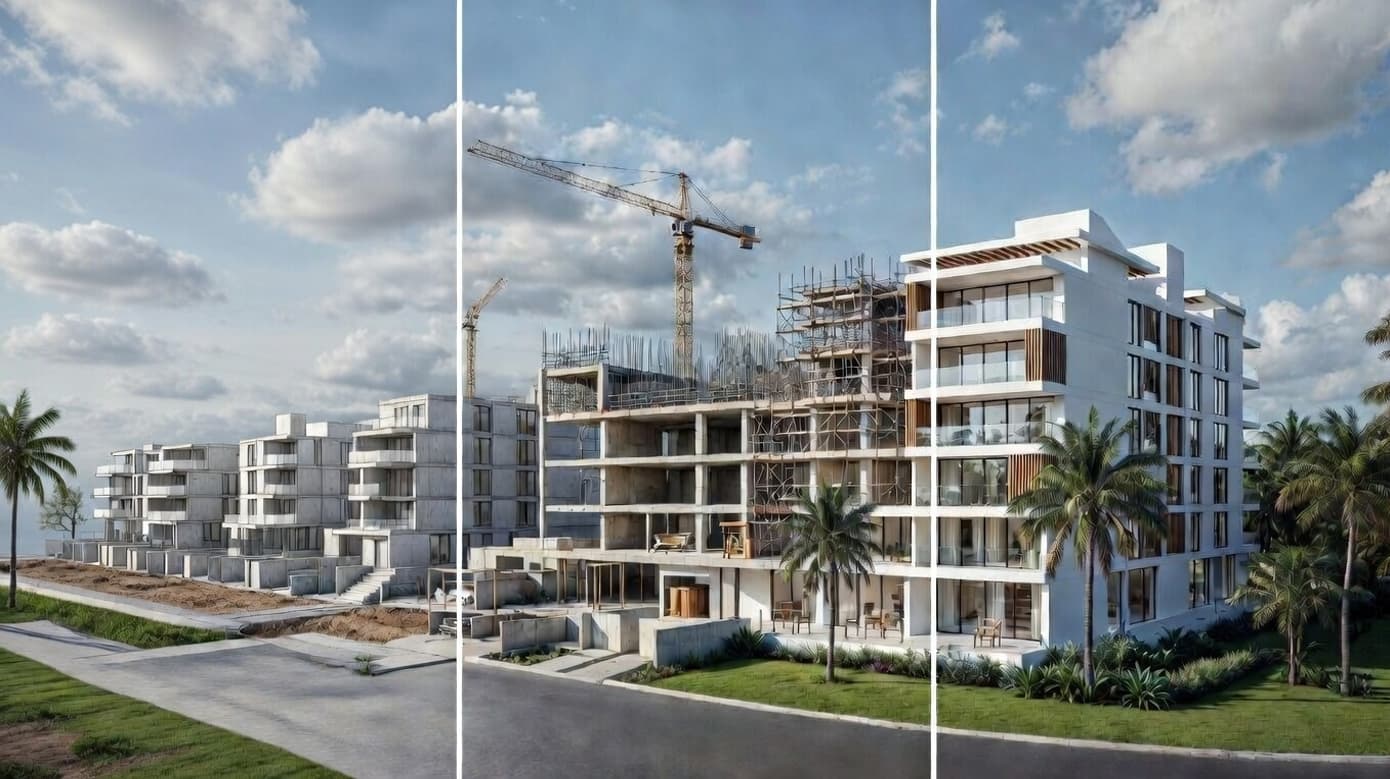
Buying property off-plan requires trust, especially when investing abroad. In Mauritius, that trust is backed by law. VEFA (vente en l'état futur d'achèvement) is the legal framework governing off-plan purchases, and it offers foreign buyers a structured system of deposit caps, payment milestones, and completion guarantees. For international investors, these legal safeguards are essential to making a secure property investment.
Whether you're looking at a PDS villa, a Smart City apartment, or a G+2 off-plan investment property, understanding how VEFA works will help you navigate the process with confidence and spot potential issues before they become problems.
What VEFA Actually Means
VEFA is one of the statutory forms used for qualifying off-plan sales in Mauritius. For residential, or mixed professional-and-residential property sold before completion with pre-completion payments, the contract must generally take the form of VEFA or vente à terme.
Under a VEFA contract, the buyer acquires ownership of the land and completed works immediately. As construction progresses, each new element transfers automatically, while the developer remains responsible for the build as maître de l'ouvrage until réception des travaux.
This is not simply a marketing term. It's a defined legal structure in the Mauritian Code civil, and it comes with mandatory protections.
For residential property, or mixed professional and residential property, any structure requiring the buyer to pay or deposit funds before completion must take the legal form of VEFA or vente à terme. Failing this, the contract is null.
This is not a technical detail. It is what forces the use of notarised contracts with specific clauses and requires a completion guarantee or refund guarantee where the law makes this necessary for validity.
Can Foreign Buyers Buy Under VEFA in Mauritius?
Yes, foreign nationals can buy off-plan property in Mauritius, bu t only through routes.
Foreign buyers can purchase off-plan property in Mauritius through approved channels, notably PDS, Smart City and eligible G+2 apartment acquisitions. IHS also exists, but it falls into a different category, as it relates to hotel units sold under a compulsory leaseback structure.
In practice, off-plan property sales in these approved channels are structured through a VEFA contract or “vente à terme”.
For non-citizens, purchasing also requires authorisation under the applicable non-citizen property restriction framework, with EDB handling the relevant approval pathway.
How to Buy Off-Plan Property in Mauritius
VEFA is not limited to foreign buyers. In Mauritius, it is a legal framework for qualifying off-plan sales and can apply to Mauritian buyers as well. For non-citizens, the additional question is whether the property can be acquired through an approved route under the applicable rules.
Here is the typical sequence for a foreign buyer purchasing off-plan in Mauritius:
Reservation agreement. You may sign a preliminary reservation contract, often referred to in practice as a Contrat de Réservation Préliminaire (CRP), or proceed directly to the notarised VEFA deed depending on the project and timing.
Documentation. You provide the KYC and supporting documents required for the transaction, typically including identification, proof of address and source-of-funds documentation.
Deposit to escrow. If a preliminary contract is used, the reservation deposit must be held by the designated depositary in the special account required by law.
Authorisation. The notary submits the application for non-citizen authorisation, and the transaction then follows the applicable approval process.
Title deed signature. Once authorisation is granted, you sign the notarised VEFA contract (acte de vente). The completion or refund guarantee must be evidenced at this stage.
Stage payments. You pay according to the appel de fonds schedule set out in the contract, subject to the applicable legal caps, until delivery.
Handover. You inspect the completed unit, note any defects, and either pay the final balance or consign it if there are conformity issues.
Off-Plan Deposit and Refund Rules in Mauritius
One of the most protective aspects of Mauritian VEFA law is how strictly it controls deposits.
Reservation deposit caps
5% if the final sale will be signed within one year
2% if within two years
0% if the delay exceeds two years
Key protections
No payment before a valid contract is signed
No funds can be called before they are due
The reservation deposit must be held by a depositary under the legal rules applicable to the preliminary contract
The preliminary contract should identify the depositary and the account used to hold the reservation deposit until signature of the notarised deed.
Refund triggers
If the sale is not concluded, the Code civil provides for refund in several situations:
The seller fails to conclude the sale
The proposed deed materially departs from the preliminary contract
The price exceeds the forecast by more than 5%
Financing is not obtained
Significant reductions in value beyond the legal thresholds
The Code civil provides a maximum three-month timeline after the refund request, subject to proof of entitlement.
Payment Milestones under VEFA
Mauritian law sets clear ceilings on how much you can be asked to pay at each construction stage. Your contract can use either periodic fixed instalments or milestone-based payments, but neither approach can exceed these limits:
Up to 35% once foundations are complete
Up to 70% at the watertight stage (mise hors d'eau, meaning roof and external walls are sealed)
Up to 95% when construction is finished
Final 5% only when the unit is made available to you, with consignation possible in case of dispute
The Code civil also provides for specific variants in defined situations, so your notary should confirm which statutory schedule applies to your transaction.
Completion and Refund Guarantees
VEFA contracts in Mauritius must include either a completion guarantee (garantie financière d'achèvement or GFA) or a refund guarantee where required for the deed's validity. This isn't optional in those cases; it's a legal requirement for the contract to be valid.
Completion guarantee. This ensures the building will be finished even if the developer runs into financial trouble. It typically takes one of two forms: a credit facility where a bank commits to advancing funds needed to complete construction if necessary, or a surety arrangement where the guarantor becomes jointly liable with the developer for completion.
Refund guarantee. This works differently. If the sale is cancelled due to non-completion, the guarantor must reimburse the instalments you've paid.
The guarantee should be evidenced at signature, and the notary should be able to show the relevant guarantee instrument.
These guarantees end when completion is formally established, either through a certified professional declaration or through the verification process provided by law.
Delivery and Final Payment
The handover process under VEFA follows a structured sequence designed to protect buyers at each stage:
Construction completion: the building is finished and you've paid up to 95% maximum
Unit made available: you receive access to inspect your property
Final 5%: payable on handover, unless you identify conformity issues
Réception des travaux: the developer retains the powers of maître de l'ouvrage until this formal acceptance; under VEFA, ownership of the land, existing works and future works transfers progressively under the legal framework set out in the Code civil
The practical handover typically includes a snagging inspection where you note any defects, missing items, or differences from specifications. If there are issues, you can withhold or consign the final balance until they're resolved. This is your leverage point.
Due Diligence Before You Commit
What to Check Before Signing
the developer’s delivery track record
the guarantee instrument and guarantor
the annexed plans and specifications
the delivery date and delay clauses
the deposit holding arrangements
the effect of non-citizen approval on the transaction
Frequently Asked Questions
Is VEFA only for foreign buyers in Mauritius?
No. VEFA is not specific to foreign buyers. It is one of the statutory forms used for qualifying off-plan sales in Mauritius, alongside vente à terme.
What happens if a developer fails during construction?
Where required by law, the contract must be backed by a completion guarantee or a refund guarantee. Depending on the guarantee in place, the guarantor must fund completion or reimburse the sums paid.
Who holds the reservation deposit?
The reservation deposit must be placed in a special account with a depositary, such as an authorised institution or a notary.
Can a developer ask for any payment schedule?
No. The Code civil caps payments at 35% after foundations, 70% at watertight stage, 95% at completion, with the balance payable on handover, subject to consignation in case of dispute.
What if the completed property does not conform to the contract?
The final balance may be consigned if there is a conformity dispute. Further remedies depend on the contract and the applicable legal framework.
When does VEFA not apply?
VEFA does not apply to completed-property sales. For qualifying off-plan residential or mixed-use sales involving pre-completion payments, the contract generally has to be VEFA or vente à terme.
Ready to explore off-plan property in Mauritius?
Explore available properties in Mauritius or contact our team if you would like more information about the buying process.
Sources
Acquisition and Lease of Immovable Property by Non-Citizens – EDB Guidelines (English)
Guidelines for the Acquisition of Apartments by Non-Citizens – EDB (English)
Economic Development Board (Property Development Scheme) Regulations 2015 (English)
Economic Development Board (Invest Hotel Scheme) Regulations 2015 (English)
Economic Development Board (Smart City Scheme) Regulations 2015 (English)
This article is provided for general information as of April 2026 and does not constitute legal, tax, investment, or regulatory advice. Applicable laws, regulations, and administrative requirements may change, and the protections available to a buyer depend on the specific wording of the notarised deed, any preliminary reservation contract where used, and the guarantee instrument. Readers should obtain independent advice from a Mauritian notary and, where appropriate, an independent lawyer before signing any document or paying any amount.
About the Author